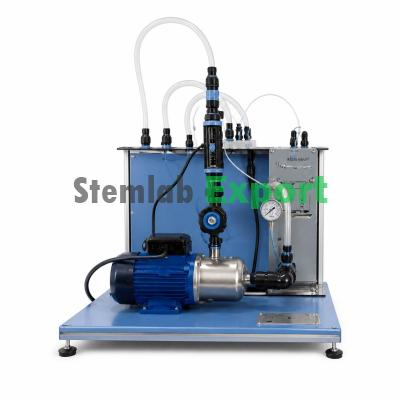
Battery Energy Storage Power Plant
Product Overview
The Battery Energy Storage Power Plant, to demonstrate the importance of energy storage in isolated environments. There are cases in which due to the absence of wind or photovoltaic energy we have no other option than to resort to the storage of chemical energy by means of batteries.
Technical Specifications
ATENG 11446 � Battery Energy Storage Power Plant
- The Conventional Power Plant, �ATENG 11440�, includes the following elements:
- N-ALI12. Power Supply Module with Phase Sensor 3PH+N/400 VAC.
- Supply voltage: 400 VAC, 3PH + N.
ON/OFF removable key.
- Output voltage connections:
- Three-phase + Neutral: 400 VAC.
- Single-phase: 230 VAC.
- Three-phase supply hose with IP44 3PN+E 32 A 400 V connecting plug. N-ALI012
- Differential magnetothermal 4 poles, 25 A, 30 mA AC 6 KA.
Emergency stop push-button.
- GMG4.5K3PH. 4.5 kW Generator-Motor Group.
Motor-generator group coupled in an aluminum frame with wheels.
- Generator nominal power: 4.5 kVA.
- Generator nominal speed: 3000 rpm.
- Generator nominal output current: 6.5 A.
- Generator nominal excitation current: 4 A.
- Generator power factor: 0.8.
- Generator nominal output voltage: 3 x 400 VAC.
- Frequency: 50/60 Hz. GMG4.5K3PH
- Motor nominal power: 5 kVA.
- Motor nominal current: 7.2 A.
- Motor nominal speed: 3000 rpm.
- N-EALD/M. Power Network Analyzer with Modbus TCP/IP Module.
This network analyzer module allows measurement, visualization, and analysis of all electrical
parameters in AC electrical networks. It features an LCD screen and navigation buttons for the
menus. Includes specialized software for monitoring voltage and current waveforms, harmonic
visualization, tariff programming, alarm programming, and storage of electrical parameters.
- Features:
- Multifunctional three-phase power meter:
- Three-phase and single-phase voltage. Up to 690 VAC L-L. N-EALD/M
- Line and neutral nominal current: 10 A.
Active, reactive and apparent power.
- Suitable frequencies: 25 Hz, 50 Hz, 60 Hz and 400 Hz.
Display of the V-I vector diagram.
- Supply voltage: 85 � 265 VAC.
- Powerquality control:
Measurement of individual current and voltage harmonics up to the 40th harmonic.
Voltage and current THD, TDD, and K-Factor.
Maximum and minimum value display.
Waveformdisplay, 128 samples/sec.
- Events and data storage:
- Harmonic analyzer:
Voltage and current THD, current TDD and K-Factor, up to the 40th harmonic.
Harmonic spectrum and phase angles for current and voltage
- Tariff programming:
Class 0.5S IEC 62053 � 22, active and reactive power in four quadrants.
Measurement of the total and per phase three-phase active, reactive and apparent powers.
Usage time, four energy/demand records of total tariffs.
Eight tariffs, four seasons and four types of days.
Automatic daily report of energy consumption maximums and minimums.
- Communications:
Modbus TCP/IP communication port.
- GEC-KIT-1. Generator Excitation Circuit Kit 1.
- N-AVR/P. Automatic Voltage Regulator Module.
- Input voltage: 0 � 100 VDC.
Input for voltage regulation signal through PWM control.
Terminals for PWM signals monitoring.
- Output voltage: 0 � 100 VDC.
- DC ammeter for output current measurement, 0 � 4 A.
N-AVR/P
3-pin female connector for connection to the excitation input of a generator.
- Fuse 5 A.
7
Specifications
- N-TRANS04. Single-Phase Transformer Module 230 VAC/2 x 35 VAC, 300 VA.
- Single-phase 230 VAC input terminals.
- Terminals for a 70 VAC single-phase output.
- Terminals for two 35 VAC single-phase outputs.
- Two-position switch: 0 (open)/1 (closed).
- Fuses: N-TRANS04
- Primary side: 2 A.
- Secondary side: 5 A.
- N-SPAD01. Single-Phase AC/DC Converter Module 1.
- 0 � 230 VAC single-phase input terminals.
AC/DC rectifier.
DC output terminals.
Filter capacitor for voltage ripple reduction.
N-SPAD01
Bypass terminals for filter capacitor connection.
- Fuse 5 A.
- N-ERP-PGC03. Power Generation, Control, Measurement, and Protection Module.
- Automatic speed and voltage controller:
Enables to connect up to 16 electric generators in parallel-island with active and reactive
power distribution and start/stop operation control depending on the load demand.
Enables to connect a generator in parallel with the grid.
It allows different switch control modes, such as opening, closing and synchronization.
Three-phase measurement of the grid and the generator voltage.
Three-phase measurement of the generator current and power.
Single-phase measurement of the grid current.
- Protection system:
N-ERP-PGC03
- Generator: Maximum/minimum voltage (59/27), maximum/minimum frequency (81O/U)
voltage asymmetry, detection of dead busbars, overvoltage (32), load unbalance (46), negative
sequence power/reduced power (32R/F), overcurrent by defined curve (50/51), inverse time
overcurrent (IEC255), measured ground fault (50N/51N), phase rotation, switches faults.
- Network: Maximum/minimum voltage (59/27), maximum/minimum frequency (81O/U), vector
jump, phase rotation.
Measurement terminals.
Output terminals for the connection to the lab grid.
- 2 mm terminals for monitoring the PWM regulation of the excitation and speed signals.
- Three control switches:
Start and stop the turbine.
Give permission to synchronize the generator with the grid.
Give permission to synchronize the generator with the national grid.
- Two potentiometers:
Adjust the set point for the generated active power.
Adjust the set point for the output voltage.
- Emergency stop push-button:
Two circuit breakers for operation in synchronization and island mode with indicator lights.
- N-BUS13. Generator Interconnection Busbar Module.
- Connection status indicators:
- SOURCE 1: Conventional power plant (ATENG 11440) connected.
- SOURCE 2: Wind power plant (ATENG 11443) connected.
- SOURCE 3: Hydroelectric power plant (ATENG 11441) connected.
- SOURCE 4: Photovoltaic power plant (ATENG 11444) connected.
N-BUS13
- SOURCE 5: Battery energy storage plant (ATENG 11446) connected.
- SOURCE 6: Flywheel energy storage plant (ATENG 11447) connected.
- GRID: Electricalgridconnected.
- LOAD: Loadsconnected.
- 2x BUS VOLTAGE: lit when voltage is applied to the busbar.
LED indicators for CLOSED and LOCKED (CB1, CB2, CB3, CB4, CB5, CB6 NET).
ON/OFF switch.
Operating status indicator.
8
Specifications
- TPEL/1800W. Single-phase AC/DC Electronic Load of 1800W (3 units).
The TPEL/1800W electrical load stands out for its versatility in operating in both AC and DC.
- With a wide power range from 0 to 1800VA and an adjustable frequency from 45 Hz to 450 Hz
this electronic source offers exceptional capabilities.
With its advanced measurement capabilities, 7-inch LCD display, and features such as the built-in
oscilloscope, the TPEL/1800W is the ideal solution for laboratory testing of most of �s unit
such as UPS, inverters, AC power supplies, electrical generators and AC electronic components.
In addition, its connectivity via LAN and USB interfaces ensures reliable and fast control, adding
an additional level of efficiency to its capabilities.
- Technical Features:
- Frequency Range: 45 Hz~450 Hz. TPEL/1800W
- Power Range: 0~1.8 kVA.
- Voltage Range: 50-420 Vrms, 15-260 Vrms.
- Parallel Connection/Three Phase Control: Capacity can be extended up to 43.2 kVA.
- 7 Inch LCD Display: Provides a clear and accessible interface.
- Oscilloscope Function: Allows display of voltage and current waveforms.
- High Speed AD Sampling: Captures real-time waveforms.
- Measurement Modes: Includes Vrms, Vpk, Vdc, Irms, Ipk, Idc, W, VA, VAR, ATENG 11797, PF and FREQ.
- Harmonic Measurement: Up to harmonic 50 (THD-V).
- AC Electronic Load: DC/CR/CP modes.
- DC Electronic Load: DC/CR/CP/CV modes.
- External Analog Control: 0~10 V analog input, with voltage and current monitoring functions.
- Protection Functions: OTP, OCP, OVP, UVP and OPP.
- Communication Interfaces: LAN and USB, plus external interface for USB flash disk.
- EMG-SCADA. Data Acquisition and Energy Management Software.
The �EMG-SCADA� software is the central component for supervision, operational control, and
energy management within the �ATENG 11438� system. Specifically designed for advanced technical
training environments and professional applications, this platform enables comprehensive
monitoring, dynamic operational control, and detailed analysis of every element within a hybrid
microgrid. Through a highly intuitive and functional graphical interface, �EMG-SCADA� provides
real-time access to a wide range of critical variables such as voltage, current, frequency, active and
reactive power, state of charge of storage systems, grid conditions, and generation performance.
Its realistic and educational approach makes it a tool fully aligned with the current requirements
EMG-SCADA
of grid operators, technical instructors, and engineers specializing in renewable energy and
microgrid systems.
- SystemPlant Management:
Configuration of the most relevant parameters for each plant.
- Selection and configuration of control modes: Grid-Forming / Grid-Following.
Start-up, shutdown, connection and disconnection control of plants and loads.
Dynamic adjustment of setpoints for each plant.
Execution of synchronization operations with the external grid or in island mode.
- Real-Time Monitoring:
Power flow visualization across the microgrid.
- Continuous monitoring of key parameters:
- Power: Active (W), Reactive (VAr), and Apparent (VA).
Line and phase voltages and currents.
Frequency.
Power factor (PF).
- Grid parameters: voltage, frequency, and phase.
- Setpoints: Voltage (V), frequency (f), power (P).
Synchronization states of each generation unit.
Alarmvisualization and management.
Plant connection and synchronization management via breakers.
Capability to graph a wide range of recorded parameters during simulation.
- Simulation and Validation of Energy Management Strategies:
- Creation of custom operation profiles: simulation of daily production cycles (solar/wind) using
real patterns or user-defined scenarios.
- Load demand profiling: based on actual consumption patterns or customized user data.
Plotting and Analysis of Various Measurable System Variables.
9
Specifications
Battery Energy Storage Power Plant Related Products
Other specialized products for engineering, technical educational and scientific laboratories such as Battery Energy Storage Power Plant.
Buy Battery Energy Storage Power Plant from India's Trusted Manufacturer
Stemlab Export is a leading manufacturer and exporter of laboratory and scientific equipment in India, supplying institutions and bulk tenders worldwide — with direct factory pricing, recognised standards and global exports.
Direct from Factory
No middlemen — manufacturer pricing, full quality control and quick quotations on every product.
Standards Compliant
Built to recognised standards such as ASTM, IS and BIS where applicable, accepted by institutions and tenders.
Bulk & Tender Quantities
Supplied in bulk volumes to procurement bodies, education ministries and global tenders.
Worldwide Shipping
Exports to 30+ countries with complete documentation and logistics handled in-house.
Who Uses Our Battery Energy Storage Power Plant?
Our Battery Energy Storage Power Plant is engineered for teaching laboratories, research facilities, government projects and international export contracts. Every unit ships with quality documentation, standards compliance and dependable after-sales support.
Institutions choose Stemlab Export for transparent pricing, on-time delivery and decades of manufacturing experience across hundreds of scientific, educational and engineering products — from school science labs to advanced research benches.
Bulk Order of Battery Energy Storage Power Plant?
Send us your requirement list or tender BOQ and we'll respond with a fully compliant manufacturer quote. Trusted by institutional and government buyers worldwide.


-lab-1566397150.jpg)