
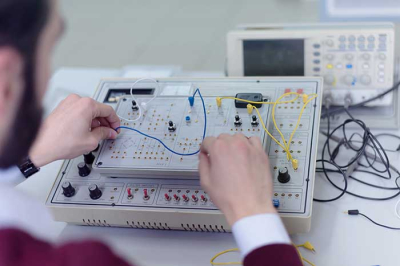
Industries everywhere are changing faster than classrooms can keep up. Automation, smart manufacturing, renewable energy, and advanced diagnostics have raised the bar for what a "qualified" technician looks like. Employers no longer want graduates who merely understand theory; they want people who can walk onto a shop floor and start working. This shift is exactly why technical training equipment has become the cornerstone of modern education, turning abstract concepts into practical, job-ready competence.
As a technical education equipment manufacturer, supplier, and exporter based in India, we've spent decades watching this transformation unfold, and building the lab systems that make it possible.
Why Practical Training Outperforms Theory
There's a well-worn gap between what students read in a textbook and what they can actually do. A learner might understand the principle behind a hydraulic circuit or a PLC control loop, yet freeze when handed the real hardware. Technical and Vocational Education and Training (TVET) exists to close that gap.
When students physically wire an electrical training board, program a CNC training machine, or diagnose a fault in an automotive simulator, learning becomes muscle memory. Troubleshooting stops being a chapter title and becomes an instinct. This is the core promise of well-designed technical education equipment: it lets learners apply theory in real situations, sharpen problem-solving skills, and build confidence with the same tools and systems they'll encounter in industry.
What Counts as Technical Training Equipment?
Technical training equipment covers the tools, machines, instruments, and simulation units used to deliver hands-on, skill-based learning. It spans an enormous range of disciplines, but a few categories anchor most training labs.
Electrical training boards teach the fundamentals of circuits, wiring, switching, and fault-finding. Automotive training simulators recreate real vehicle systems so learners can develop diagnostic and repair skills safely. Welding training equipment builds accuracy and safety awareness across multiple techniques, while CNC training machines introduce precision machining and automation.
Beyond these, HVAC training equipment develops installation and servicing ability, plumbing training kits teach pipe fitting and system assembly, and computer laboratory equipment supports programming, networking, and cybersecurity training. Manufacturing training systems simulate industrial automation and PLC control, renewable energy lab equipment introduces solar, wind, and energy-storage concepts, and construction training tools build real-world site skills. Each system exists for one reason: to convert knowledge into capability.
Who Uses Technical Training Equipment?
The reach of this equipment is genuinely broad. Vocational schools, technical institutes, polytechnics, and ITIs form the core, but the list extends far wider. Community colleges, Career and Technical Education (CTE) high schools, apprenticeship programs, and trade schools all depend on hands-on systems. So do adult education centres, military training centres, corporate training centres, prison education programs, and research and development centres.
What unites them is a shared goal: equipping individuals with the practical skills and knowledge they need to succeed in specific technical trades and professions. Across all of these settings, technical training equipment supports national skill initiatives and workforce development programs by preparing genuinely industry-ready professionals.
How to Choose the Right Technical Training Equipment
Not all lab equipment delivers the same results, and the wrong choice can waste both budget and learning time. A few principles help institutions choose wisely.
Start by defining clear training objectives and aligning equipment with current industry standards, so students learn on systems that reflect real workplaces. Prioritise quality and durability, because equipment used daily by dozens of learners must withstand heavy handling. Safety features are non-negotiable in any training environment, and ease of use keeps the learning curve manageable for beginners.
It also pays to think ahead. Scalable, modular systems can grow with your curriculum, while strong maintenance and technical support protect your investment over the long term. Finally, weigh customisation options, budget, technology integration, and environmental impact before committing. The best equipment balances all of these rather than excelling at just one.
Why Sourcing From a Trusted India Manufacturer Matters
Choosing a supplier is as important as choosing the equipment itself. As a technical educational equipment exporter operating from India, we've supplied more than 60 countries across Asia, Africa, the Middle East, and Europe, and we manufacture every product under ISO-certified quality systems.
Institutions partner with us for in-house manufacturing and engineering expertise, curriculum-aligned designs, and consistent, repeatable performance. We also handle the practical side of large procurements: export-ready documentation, secure packaging and logistics, OEM and private-label manufacturing, and custom specifications built to match international tenders and curricula. For government and institutional buyers, that tender-ready capability removes a major source of friction.
Preparing Students for What Comes Next
The purpose of technical education has always been to erase the distance between the classroom and the workplace. Well-equipped laboratories do exactly that. They let learners practise installation, diagnostics, maintenance, and troubleshooting in a safe, controlled environment, building the confidence and competence that employers actively seek.
By investing in reliable, industry-relevant technical training equipment, institutions raise learning outcomes, improve employability, and help meet the growing demand for skilled technicians across engineering, manufacturing, automation, renewable energy, and beyond. The right equipment doesn't just teach a subject; it launches a career.
Ready to equip your lab? Request a custom quote or download our full technical education equipment catalogue today.